
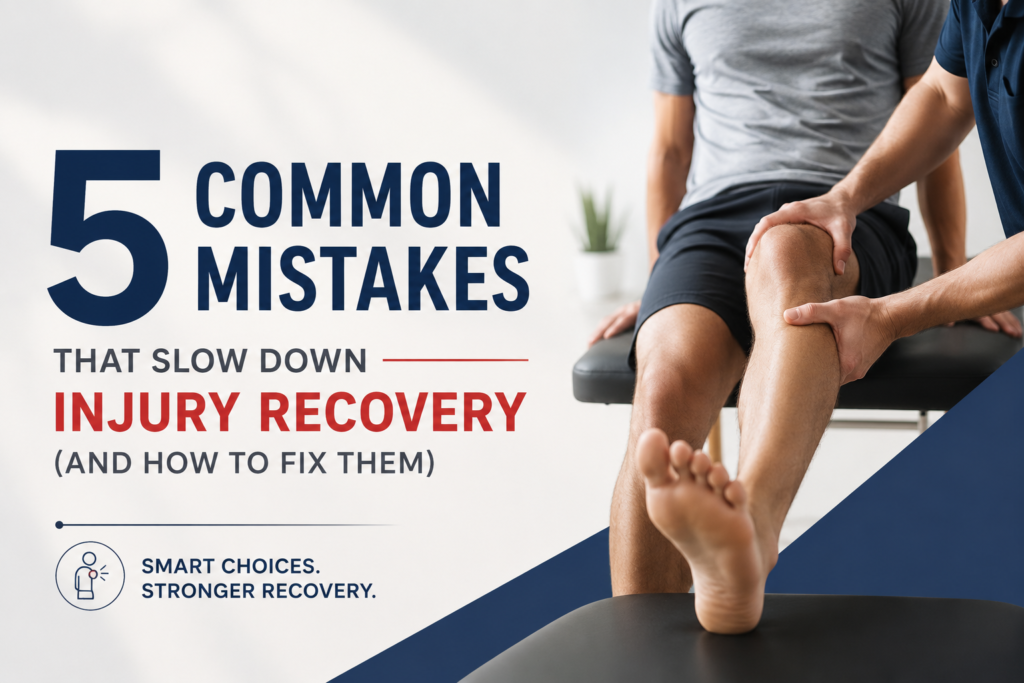
5 Common Mistakes That Slow Down Injury Recovery (And How to Fix Them)
Whether you have been suffering through a sports injury or orthopedic surgery, or simply enduring persistent joint stiffness, it can be disheartening to see your progress stop in its tracks. Everyone assumes that recovery just involves giving time some time. But in reality, recovery is not a passive process—it’s an active one—and many daily habits can actively interfere with how your body tries to heal itself.
At UNIQ Physical Therapy, our clinical team of doctors consistently sees patients who are highly motivated to recover but fall victim to the recovery pitfalls without even realizing it.
Here are five of the most common roadblocks to your recovery and how you can fix them.
1. Relying on “Total Rest” for Too Long
Of course, it is quite normal to shield a joint or muscle from further injury immediately following an episode of strain. However, the act of remaining on the sofa after a few weeks of the injury has passed is doing more damage than good.
Tissues start to weaken and deteriorate, while non-moving connective tissues become tight and inflexible. Movement promotes increased blood flow to the affected area, thus delivering nutrients to the tissues.
Fix: Stop passive rest and move to “active recovery.” Moving helps to build collagen fibers in the body.
2. Treating Symptoms Instead of the Root Cause
While grabbing an ice pack or popping an over-the-counter painkiller may help you numb your pain for the time being, pain is only an indicator that something is wrong. For instance, if your knee pain is actually due to unstable hip joints or bad feet mechanics, numbing yourself from the pain will not prevent future injury to your knee joint.
As you only treat where it hurts without understanding why it hurts, once you resume physical activities, that irritation will come back in full force.
The Solution: Undergo a complete movement evaluation. By working with an expert who assesses your body movement mechanics, you ensure that the source of irritation is resolved rather than treated.
3. Quitting Therapy as Soon as the Pain Fades
The main cause of injuries becoming recurrent is because one stops rehabilitating too soon. It’s natural for pain to be the first symptom that vanishes from the process of recovering, but rebuilding the strength, stability, and neural coordination of your body takes quite some time.
When you start doing heavy weightlifting, jogging, or strenuous gardening activities the moment you feel like yourself again, your body is probably not working at 100% but rather at 60-70%.
The Fix: Follow your rehab program until you meet functional performance milestones—such as full strength, restored range of motion, and dynamic balance—not just a pain-free baseline.
4. Pushing Through “Sharp” Pain
There is a significant difference between the good soreness that occurs when muscles are building themselves up and the pinching pain of injuring oneself again. The “no pain, no gain” mentality applied in rehabilitating can easily result in secondary inflammation, putting one behind schedule by weeks.
The Fix: Use the traffic light rule for exercise. Green means gentle, manageable effort; Yellow means mild discomfort that settles within 24 hours; Red means sharp, sudden, or spreading pain that tells you to stop immediately.
5. Copying Generic Exercises Found Online
The internet is riddled with “quick fixes” in the form of stretches or other forms of exercise regimens. The problem with using such forms of exercises for your back problem is that something that works well for another person may actually worsen your disc/joint problem.
The Fix: Partner with a licensed clinical expert who adapts every stretch, loading angle, and progression to your exact body structure and healing stage.
Accelerate Your Healing with Expert Local Care
Injury management should never be a guessing game. Getting an experienced physical therapist, who is doctorate trained, to analyze your movement mechanics will save you from any recovery setbacks.
If you are searching for dedicated, one-on-one physical therapy near me, our compassionate clinical team is here to guide every step of your journey:
- Montgomery County Residents: Visit our state-of-the-art clinic for Physical Therapy Lansdale, conveniently located in the Allen-Forge Shopping Center on S Valley Forge Rd.
- Bucks County Residents: Connect with our experts for Physical Therapy Warminster, situated right on York Road in the Warminster Shopping Center.
Thanks to Pennsylvania’s Direct Access laws, you can bypass referral delays and schedule your comprehensive evaluation directly with our team today.
About the Author
Dr. Ankit Patel, PT, DPT, founder of Uniq Physical Therapy, brings 10+ years of expertise to the Warminster and Lansdale communities. He earned his Doctorate from Arcadia University and previously managed clinics for industry leaders like Rothman Orthopaedics, ATI, and Novacare. Specializing in orthopedic, sports, and geriatric care, Dr. Patel is LSVT BIG Certified and integrates holistic practices like Yoga and Reiki into his evidence-based treatments. Dedicated to building deep patient trust, he focuses on non-surgical recovery and personalized care to help every individual reclaim their mobility and health.